

This is the first of a series of articles focused on interpretation of our written Constitution that I expect to post over the next few months.
As the British Constitution is the most subtle organism which has proceeded from the womb and the long gestation of progressive history, so the American Constitution is . . . the most wonderful work ever struck off at a given time by the brain and purpose of man.[1]
In early May 1787, a convention of state delegates convened in Philadelphia (the “Constitutional Convention”) to address the infirmities and the foreign and domestic problems caused by the Articles of Confederation.[2] After four months of intense debate, a draft of a new written constitution was completed and presented to the delegates for signing on September 17, 1787. Some delegates left the convention without signing, others remained but refused to sign, and ultimately 39 delegates from 11 states, including the lone remaining delegate from New York, Alexander Hamilton, signed the proposed written constitution. It was then presented for debate and ratification by the people through Conventions held in the individual States.
During the next two years, there was intense debate within the states over ratification of the draft constitution, led primarily by two loosely formed groups or “parties”— Federalists and Anti-Federalists. Federalists supported ratification of the proposed constitution on the grounds that it gave the national government the power and authority necessary to effectively manage and govern the affairs of the new Republic. Anti-Federalists opposed the proposed constitution because, they argued, it granted too much power to the central government. [3]
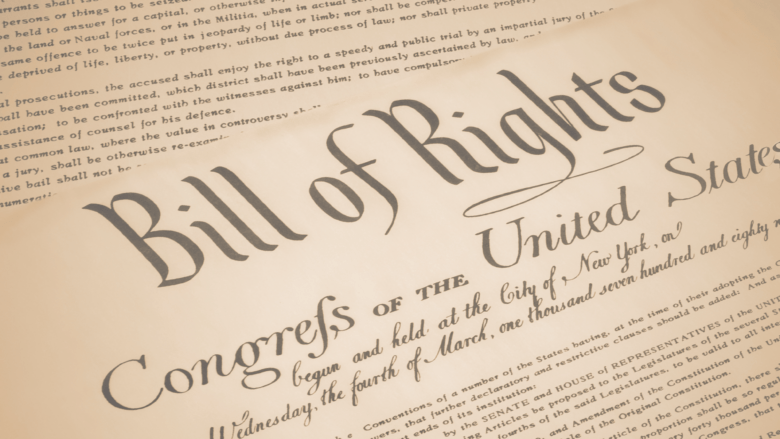
A key “sticking point” was the Anti-Federalists’ demand that a “bill of rights” be included in the proposed constitution to protect individual freedoms and rights from what they feared would become a powerful and tyrannical national government. James Madison disagreed, arguing in The Federalist 84 a bill of rights was nothing more than an ineffective and unnecessary “parchment barrier,” especially in light of the limited powers given to the national government in the proposed constitution. In other words, there was nothing in the text that allowed the national government to reduce, regulate or take away the rights retained by the people.
Ultimately, James Madison promised that if the constitution was ratified, he would propose a “bill of rights” in the First Congress. Accordingly, the Constitution was ratified, as written, by nine states and went into effect on June 21, 1788. And Jefferson, being the consummate statesman that he was, followed through on his pledge. Amendments I through X, now known as the Bill of Rights, were drafted (primarily by James Madison), adopted, and ratified as part of the written Constitution by 1791.
The Framers intended the written Constitution to be the fundamental law . . . the “Supreme Law of the Land.” It incorporated the lofty principles, “self-evident” truths, and God-given freedoms outlined in the Declaration of Independence.[4] Moreover, it introduced the novel concept of “popular sovereignty”[5] making clear in the first words of the preamble that the sovereign power in America rests with “We the People.” It also introduced fundamental principles of limited government, separation of powers, checks and balances, and federalism in its text and structure. And, as predicted by Alexander Hamilton, it was and continues to be the Nation’s “greatest security.”
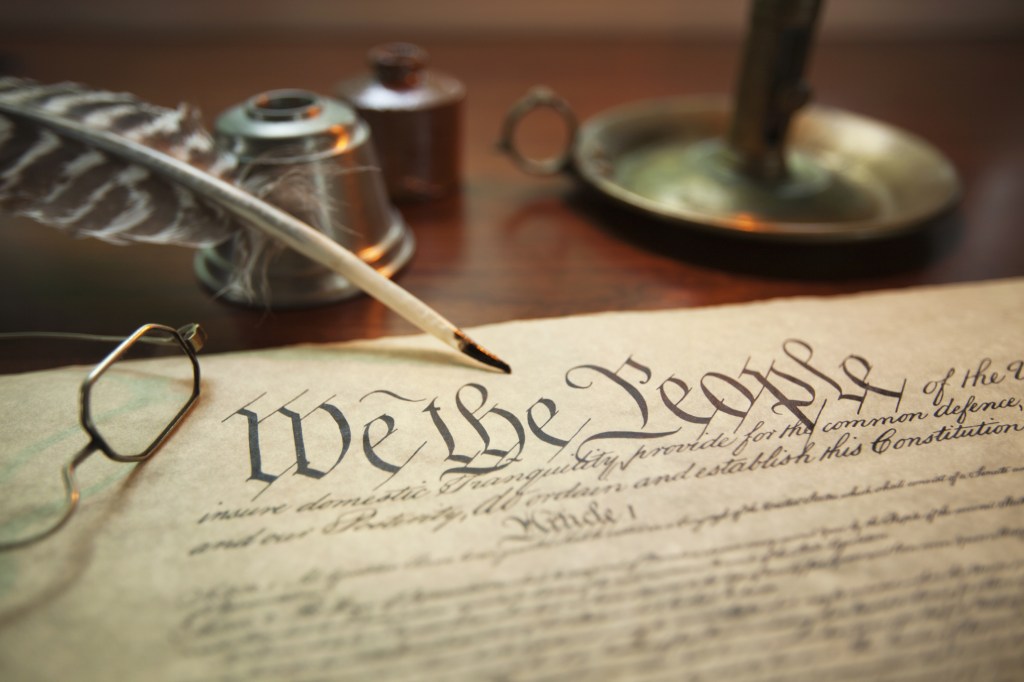
Since its ratification in 1788, the Constitution has stood before the world as a written blueprint for freedom and liberty. Over the next 230+ years, it survived the ravages of time and relentless criticism and attack from its critics and enemies, foreign and domestic. Today, it remains the oldest written Constitution in existence and is viewed by many around the world as nothing short of miraculous. It has been described as “one of the most brilliantly conceived political documents in history.”[6] And, it is because of our written Constitution, that America has been and remains the “shining city on a hill” for the rest of the world.
The success and longevity of the Constitution is due, at least in part, because it is in writing. Why is that so important? First, unlike the common law, royal edicts, treaties, and ordinary civil laws that form the basis of England’s unwritten constitution, the Constitution of the United States is the Nation’s fundamental law, created by and of the sovereign people of America—it is “of the sovereign power [of the people] by which the liberty of nature is abridged.”
As noted in 1803, by Chief Justice Marshall in Marbury v. Madison, the Constitution of the United States is different from England’s constitution:
[U]nlike the “common law” or general statutory law, the Constitution was established, not by custom as determined by the judiciary or laws enacted by a legislative body, but instead, based on the novel concept that the people, as the supreme authority . . . the sovereign authority, have an “original right” the fundamental principles of their governance that they deem most conducive to their own happiness.”
The Framers, in fact, rejected the British model and opted for a written constitution as the “fundamental and paramount law of the nation.” Thomas Jefferson confirmed that the Framers objective, from the outset, was to “form a fundamental constitution, to commit it to writing, and place it among their archives where everyone would be free to appeal to its text.”
Second, as explained by eighteenth-century political theorist and philosopher, Joseph Priestley, a written document preserves the ideas of those in the past and permits those ideas to transcend time and be communicated to future generations:
[B]y means of writing we become acquainted with the sentiments and transactions of men in all ages, and all nations of the world. It connects, as it were, the living, the dead, and the unborn: for, by writing, the present age can not only receive information from the greatest and wisest of mankind before them, but are themselves able to convey wisdom and instruction to the latest posterity.[7]
The Framers intended that the principles, rules, enumerated powers, and limitations in the structure and text of the written Constitution to be the fundamental and permanent law of the land, until and unless amended by the people pursuant to Article V.[8] Therefore, unlike England’s unwritten constitution, our written Constitution cannot be changed or amended by the courts, the legislature, or even by the President of the United States.
Third, the Constitution was written in plain, ordinary, and intelligible language so that the people could understand what was being presented to them for their acceptance or rejection, as the Nation’s sovereign populace. As described by a well-respected constitutional commentator, Akhill Reed Amar, its “crisp, intelligible language [was] designed to invite citizens into the process of serious evaluation and faithful interpretation.” Thus, it serves an educational role so that those bound by the law know what it says.
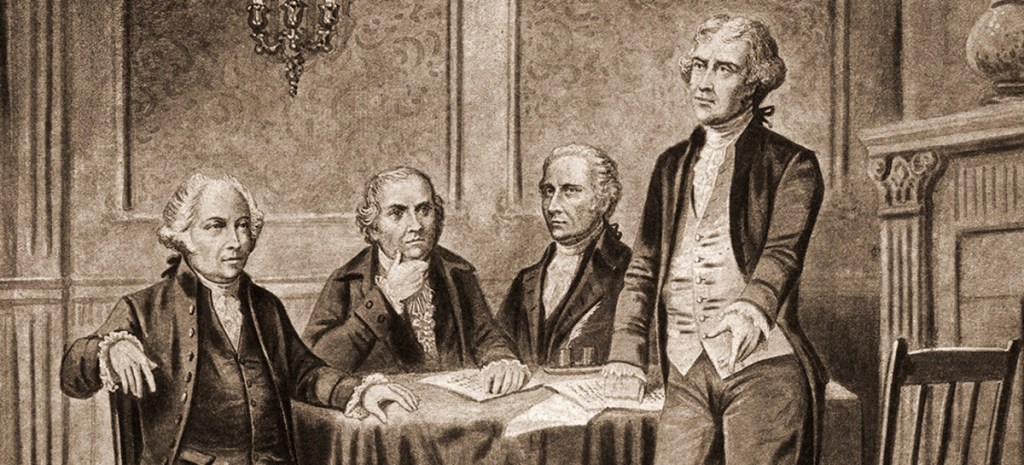
As stated by John Rastell, a sixteenth-century historian, philosopher, and author, “it followeth that the law in every realm should be so published, declared, & written, in such wise that the people so bound to the same, might soon and shortly come to the knowledge thereof or else such a law, . . . may rather be called a trap.” [9] A seventeenth-century political philosopher whose works were well-known by the Framers, Thomas Hobbes, also recognized that constitutions must be written otherwise “there is no . . . way to take notice of them.”[10]
In a letter to William C. Nicholas, dated September 7, 1803, Thomas Jefferson acknowledged the security provided by a written constitution so that its words are not construed or interpreted in a manner that makes the text meaningless:
When an instrument admits two constructions, the one safe, the other dangerous, the one precise, the other indefinite, I prefer that which is safe and precise. . . . Our peculiar security is in the possession of a written Constitution. Let us not make it a blank paper by construction.
Finally, the Constitution not only sets forth the respective powers of the three co-equal branches of government (Legislative, Executive, and Judicial) but also places specific limits, as well as “checks and balances,” and on their separate powers. Thus, it was critically important to the Framers, given the nature of mankind,[11] that those limits, checks and balances were written in the Constitution so that they would never be “mistaken, or forgotten.”
As explained by constitutional commentator, Randy Barnett, the Constitution was written as a mechanism to both “lock in” the procedural and substantive rules of governance and as a “means to impose law” on those who are empowered, by the people, to govern.
Why put a constitution in writing? There are at least two good reasons for doing so. First, because it helps ′′lock in′′ . . . legitimacy-enhancing features of a constitution . . . . Second, a written constitution was devised as a means to impose law on those who impose laws on the governed. In other words, it was way to impose law on law-makers, interpreters, and enforcers. Such a law is meant to restrict the exercise of law-making to actions that respect the rights retained by the people.[12] (Emphasis added)
Although our Constitution was written so both those protected by and those bound by its terms and limitations could “appeal to its text” and would “know what it says,” unfortunately, it has never been quite that easy. In the sixteenth-century, Hobbes recognized that ambiguities sometimes are just inherent in language and other times may be fabricated such that written law often must be interpreted.[13]
Hobbes also warned that with the need for interpretation comes the danger “that men will judge what is lawful or unlawful not by the law itself, but by their own consciences; that is to say by their own private judgments.”[14] Today, purported ambiguities in our written Constitution are often nothing more than rank fabrications by clever attorneys and politicians advocating a modern-day constitutional interpretive philosophy known as Living Constitutionalism, a philosophy that threatens to make our written Constitution a nothing more than a “blank paper.”
END NOTES
* Don Petrie is a 30-year attorney in Chandler, Arizona.
[1] William E. Gladstone, Kin Beyond Sea, The North American Review (September–October 1878), at 185; see also The Originality of the United States Constitution,
[2] The Articles of Confederation and Perpetual Union (“Articles of Confederation”), ratified in 1881, was the country’s first written constitution. It focused on preserving the independence and sovereignty of the individual States and severely limited the powers of the central government. Under the Articles of Confederation, Congress was weak and virtually powerless; it had neither the power to enforce federal law nor the power to tax or to compel the states to contribute the funds necessary to run the government. The infirmities of the Articles of Confederation ultimately led to the Constitutional Convention in Philadelphia in 1987.
[3] The Federalist was a series of essays authored under various pseudonyms by prominent Federalists, Alexander Hamilton, John Madison, and John Jay, setting forth their arguments for ratification. “The Federalist Papers are considered one of the most important sources for interpreting and understanding the original intent of the constitution.” https://www.loc.gov/rr/program/bib/ourdocs/federalist.html (quoting Library of Congress website, Primary Documents). Thomas Jefferson described TheFederalist as “the best commentary on the principles of government which ever was written.”
[4] The second paragraph of the Declaration of Independence states::
WE hold these Truths to be self-evident, that all men are created equal, that they are endowed by their Creator with certain unalienable Rights, that among these are Life, Liberty and the pursuit of Happiness.—That to secure these rights, Governments are instituted among Men, deriving their just powers from the consent of the governed, . . .
[5] Under the concept of “popular sovereignty,” the power to rule rests with the people, “as individuals.” As indicated in the Declaration of Independence, the purpose of government is to “secure these rights” through power derived from the “consent of the governed,” the people.
[6] Sadly, despite swearing an oath to uphold and defend the Constitution, some former and current justices on the Supreme Court would disagree. Most notably, in a 2012 television interview in Egypt, former Supreme Court justice Ruth Bader-Ginsburg (deceased) openly disparaged the Constitution as one that she would not “look to” if she were “drafting a constitution in . . . 2012,” remarkably opting instead for South Africa’s constitution, Canada’s 1982 Charter of Rights and Freedoms, or The European on Human Rights.
[7] Joseph Priestley, A Course of Lectures on the Theory of Language and Universal Grammar (Warrington: W. Eyres, 1762).
[8] The Constitution can be amended only as provided under Article V, which requires that amendments proposed by either two thirds of Congress or the legislatures of the States must then be ratified by three quarters of the States.
[9] John Rastell, Exposicions of the Termes of the Lawes of England (London: R. Tottel, 1567), “Prologue,” p. Aiii).
[10] Thomas Hobbes, Elements of Law: Natural and Politic, II,10.10, at 190 (1640).
[11] As James Madison stated in the Federalist No. 51:
If Men were angels, no government would be necessary. If angels were to govern men, neither external nor internal controls on government would be necessary. In framing a government which is to be administered by men over men, the great difficulty lies in this: you must first enable the government to control the governed; and the next place, oblige it to control itself.” (Emphasis added)
[12] Randy Barnett, William Howard Taft Lecture, Scalia’s Infidelity: A Critique of “Faint Hearted” Originalism, 75 U. Cin. L. Rev. 7, 18 (2006)(emphasis added).
[13] Thomas Hobbes, Leviathon 268 (1651).
[14] Id. at 264 (emphasis added).
 Cowboy Law
Leave a comment